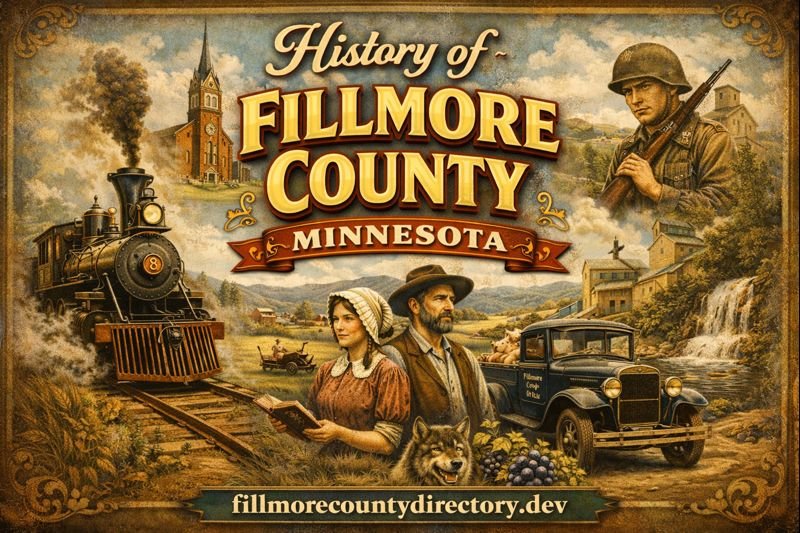
History of Fillmore County, Minnesota
Fillmore County, located in the southeastern corner of Minnesota along the Iowa border, holds a remarkable place in the state’s history. Established on March 5, 1853, the county was named in honor of Millard Fillmore, the 13th President of the United States who served from 1850 to 1853. Today, Preston serves as the county seat, and the county is included in the Rochester metropolitan area.
Early Settlement and Growth
Fillmore County was among the earliest destinations for Euro-American settlement following the United States’ 1851 treaties with the Dakota nations. Norwegian immigrants were particularly numerous among the settlers who arrived in the 1850s. The first permanent settlers began arriving in 1852, with the village of Forestville being founded in 1853 along the banks of the Root River.
The county experienced rapid growth during its early years. By 1860, Fillmore County had become Minnesota’s most populous county, a remarkable achievement for such a young settlement. The rich soil proved ideal for wheat farming, and communities like Spring Valley, Preston, and Lanesboro developed as centers of trade and commerce for local farmers.
The County Seat Question
On March 2, 1855, Carimona was designated as the first county seat. However, just one year later on March 1, 1856, voters chose Preston to become the new county seat. On February 24, 1863, the citizens of Preston decided to erect a brick courthouse 50 feet square and two stories high on a public square. Two wings were added in 1884. The present courthouse was erected in 1958 on the site of the previous courthouse.
The Railroad Era
The arrival of railroads in the 1860s dramatically shaped the county’s development. Towns located along the rail lines flourished, while those bypassed by the railroad declined. The historic village of Forestville provides a poignant example: when the Southern Minnesota Railroad bypassed it in 1868, the once-bustling community of 150 residents slowly faded. By 1890, Thomas Meighen owned the entire village, and when he closed the general store in 1910, the town became frozen in time. Today, Historic Forestville is preserved as a living history museum operated by the Minnesota Historical Society, depicting life as it was in 1899.
Ancient History and Unique Geology
Long before European settlement, the region was home to the Mound Builders, who left undisputed evidence of their occupancy. Archaeological surveys have documented numerous mounds throughout the county, including groups near Rushford and at the junction of the north branch of Root River with the main river below Lanesboro.
Fillmore County is part of the Driftless Area, a region that was untouched by glaciers during the last ice age. This unique geological history created the county’s distinctive karst topography, characterized by rolling hills, limestone bluffs, sinkholes, disappearing streams, and underground caves. In fact, Fillmore County has more caves, sinkholes, and disappearing streams than all other Minnesota counties combined.
Famous Caves
The county is home to the only two publicly accessible caves in Minnesota. Mystery Cave, discovered in 1937, is the longest cave in Minnesota, spanning over 13 miles underground. It is now part of Forestville/Mystery Cave State Park and features stalactites, stalagmites, flowstone, and underground pools.
Niagara Cave was discovered in 1924 when three local boys found it while searching for a farmer’s lost pigs that had fallen through a sinkhole. The cave opened for public tours in 1934 and features a 60-foot underground waterfall that gave the cave its name. Niagara Cave has been ranked among the top caves in America by CNN, the Travel Channel, and USA Today. It was also the first commercial cave in the world to be powered by solar energy, achieving this milestone in 2015.
Geography and Natural Features
Fillmore County covers a total area of 862 square miles. The Root River, the county’s major waterway, drains the area as it flows eastward through dramatic limestone bluffs and valleys. The North Branch, Middle Branch, and South Branch of the Root River combine their waters as they flow through the county. The terrain consists of rolling hills carved by streams and gullies, with the highest point at 1,378 feet above sea level along the western border.
Modern Tourism and Recreation
Today, Fillmore County is a destination for outdoor recreation and heritage tourism. The Root River State Trail, a 42-mile paved trail built on an abandoned railroad bed, winds through the county connecting the communities of Fountain, Lanesboro, Whalan, Peterson, and Rushford. The trail passes through towering 300-foot limestone bluffs, forestlands, and rolling fields, attracting cyclists, hikers, and cross-country skiers year-round.
Lanesboro, located at the heart of the trail system, has been recognized as one of “America’s Prettiest Towns” and is known for its vibrant arts scene, charming bed and breakfasts, and excellent trout fishing. The county’s cold spring-fed streams, kept at a constant 48 degrees by underground cave systems, make Fillmore County a premier trout fishing destination in the Midwest.
Historic Sites
Fillmore County boasts 36 sites listed on the National Register of Historic Places, reflecting its rich architectural and cultural heritage. Notable landmarks include the Preston Brewery, built in 1859 and the oldest industrial building still standing in the county; the Daniel Dayton House near Harmony, built in 1857 as one of the few remaining stagecoach inns in Minnesota; and the Rushford City Mill from 1875, which demonstrates the county’s importance as one of Minnesota’s first wheat and flour producing regions.
Population and Community
As of the 2020 census, Fillmore County had a population of 21,228. While no longer the most populous county as it was in 1860, Fillmore County maintains its strong agricultural heritage and small-town character. The county continues to be home to thriving communities including Preston, Spring Valley, Harmony, Chatfield, Rushford, Lanesboro, and Wykoff.
From its founding in 1853 through today, Fillmore County has preserved its unique blend of natural beauty, agricultural tradition, and historical significance, making it one of Minnesota’s most distinctive and cherished regions.
Need a Website for Your Fillmore County Business?
The Inventor’s Velocity offers professional web development and digital marketing services to help local businesses thrive online.
Get Your Free ConsultationWeb Design • SEO • Digital Marketing • WordPress Development
TIV360.com